A Global Classroom Without Borders
On March 8, 2026, in celebration of International Women’s Day, a dynamic online event brought together 253 participants from 21 countries in an ambitious conversation about the future of global education and the transformative role of women within it.
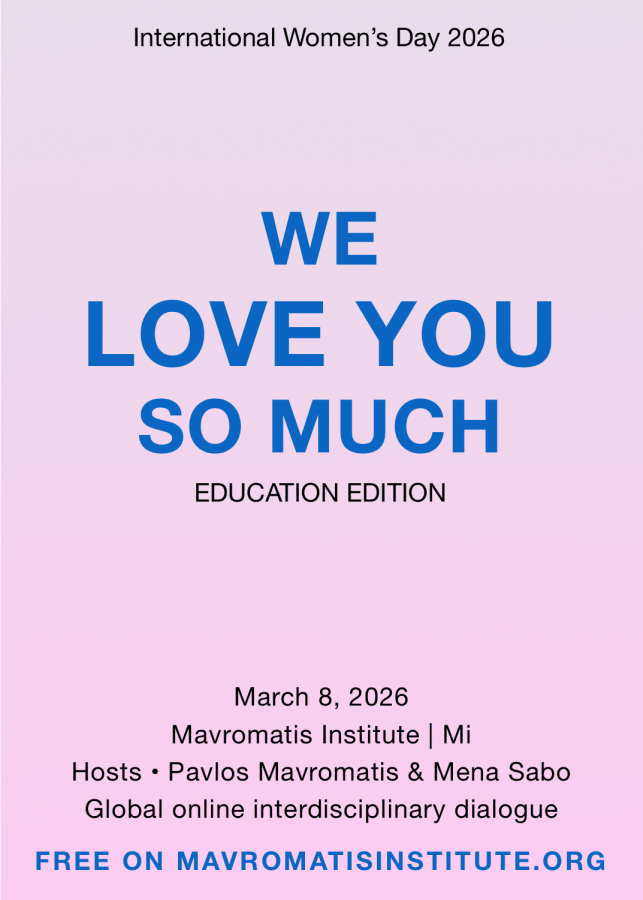
The event, titled “We Love You So Much: Education Edition”, was organized by the Mavromatis Institute | Mi and co-hosted by Pavlos Mavromatis and Mena Sabo.
More than a symbolic celebration, the gathering became a provocative interdisciplinary forum exploring how women shape education across disciplines, cultures, and technologies.
The event transformed a simple webinar into a global intellectual exchange, where participants from multiple continents reflected on one urgent question:
What does the future of education look like when women lead it?
Education Beyond Silos: The Power of Interdisciplinary Dialogue
Modern education increasingly demands collaboration across fields, from psychology and pedagogy to technology, culture, and social sciences. Interdisciplinary initiatives are rapidly becoming central to educational innovation, enabling educators to combine perspectives and design more effective learning environments.
During the discussion, speakers emphasized that women often act as the connective tissue of interdisciplinary education.
Participants explored themes such as:
- Women as architects of inclusive educational ecosystems
- Interdisciplinary teaching models connecting humanities, sciences, and arts
- The impact of digital technologies on women-led educational initiatives
- Global collaboration networks led by female educators
- The cultural intelligence required to educate across borders
Rather than presenting static lectures, the session encouraged active debate and reflection, turning the online space into a living laboratory of ideas.
Women as Catalysts of Educational Transformation
One of the most striking insights from the event was a simple but powerful observation:
When women lead educational initiatives, systems tend to become more collaborative, empathetic, and globally connected.
Participants shared examples from universities, NGOs, digital learning platforms, and grassroots educational projects.
Across countries and disciplines, several patterns emerged:
- Women frequently pioneer inclusive educational models, especially in underserved communities.
- They often act as bridges between disciplines, integrating psychology, culture, technology, and pedagogy.
- Women-led educational projects tend to prioritize community engagement and social impact.
These trends point toward a broader transformation in how knowledge is produced and shared in the 21st century.
A Conversation That Crossed 21 Countries
The diversity of the participants was itself a statement about the evolving landscape of education.
Educators, researchers, and students joined from 21 different countries, turning the event into a miniature model of global academic collaboration.
Participants exchanged perspectives on:
- Gender equality in educational leadership
- Cultural differences in educational systems
- The role of women in shaping educational policy
- Digital learning and global access to knowledge
The scale of participation demonstrated something remarkable:
Education is no longer confined to classrooms or national systems, it is increasingly a global dialogue.
Why International Women’s Day Matters for Education
International Women’s Day has long celebrated achievements in politics, science, and culture.
But education may be the field where women’s influence is most transformative.
Women represent a majority of educators worldwide, yet their leadership in shaping global educational policy and research frameworks is still evolving.
Events like “We Love You So Much: Education Edition” highlight the urgency of:
- amplifying women’s voices in academic leadership
- encouraging interdisciplinary collaboration
- fostering global educational networks
By bringing together hundreds of participants from around the world, the event illustrated how education becomes stronger when gender equality meets intellectual diversity.
The Bigger Question: Who Designs the Future of Learning?
Perhaps the most provocative takeaway from the event was a question posed to participants near the end of the discussion:
If education shapes society, who should shape education?
The conversation suggested that the answer increasingly lies in collaborative, interdisciplinary, and globally connected leadership—where women play a central role.
As digital technologies dissolve geographic boundaries and new educational paradigms emerge, initiatives like this one demonstrate that the future of learning will not be built by isolated disciplines.
It will be built by communities of thinkers working together across borders, cultures, and ideas.
And many of those voices will be women.
Event Summary
Event: We Love You So Much: Education Edition
Date: March 8, 2026
Occasion: International Women’s Day
Organizers: Mavromatis Institute | Mi
Hosts: Pavlos Mavromatis & Mena Sabo
Format: Global online interdisciplinary dialogue
Participants: 253
Countries Represented: 21